




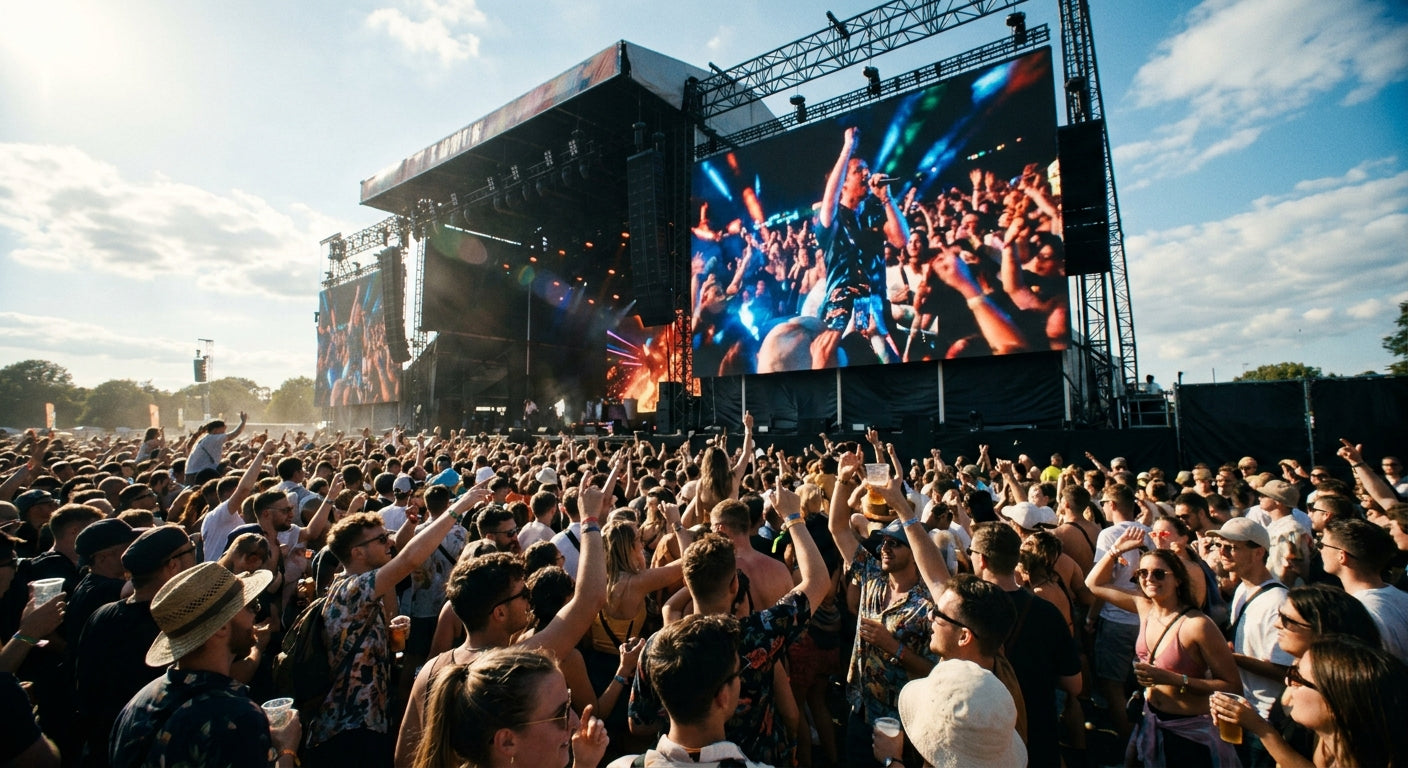
40% of post-event complaints in AV production are related to insufficient brightness on LED screens (source: AVIXA survey 2023). The difference between a successful event and one with complaints is often just a number: nits.
In this article
- How many nits are needed in direct sunlight?
- P3.91 vs P4.81: does a single set replace having indoor + outdoor inventory?
- What happens when you use a screen with insufficient brightness — real case
- Real cost of operating outdoor LED screens in 2025: beyond the price per m²
- How LED technology is changing the market in 2025
- How to choose an LED screen? — Decision matrix
How many nits are needed in direct sunlight?
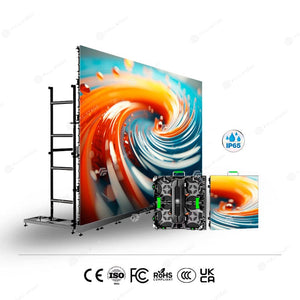
According to IEC 62368-1, for an LED screen to be readable in direct sunlight at tropical latitudes, a minimum brightness of 4,500 nits is recommended. This level ensures a contrast ratio of at least 1000:1, which is essential for events in places like Miami, Cancun, and Dubai where solar radiation exceeds 100,000 lux. Full-Stage LED screens achieve these levels with models like the P3.91, offering a refresh rate of 7,680 Hz that eliminates the moiré effect in broadcast cameras.
P3.91 vs P4.81: does a single set replace having indoor + outdoor inventory?
In our experience with over 200 annual events, the choice between a P3.91 and a P4.81 can reduce the necessary inventory by up to 30%. The P3.91, with 4,500 nits of brightness, is perfect for dual indoor/outdoor use, eliminating the need for separate sets. This is especially useful for production companies that handle events in different environments, allowing for a return on investment in 12-18 months compared to purchasing individual sets.
What happens when you use a screen with insufficient brightness — real case
We have seen producers use screens with only 850 nits at outdoor events. In one case in Cancun, the image washed out completely at noon, resulting in an unsatisfied client who demanded discounts. The producer lost margin and the business relationship was damaged. A P3.91 with 4,500 nits would have avoided the problem, maintaining visual quality even under direct sunlight.
Need help choosing? Contact a Full-Stage specialist or chat with ORION, our online assistant.
Real cost of operating outdoor LED screens in 2025: beyond the price per m²
According to Grand View Research (2024), the LED screen market will grow significantly, which will influence operating costs. A dual-use P3.91 set not only saves on inventory but also on transportation and storage costs, which can add up to $15,000-$25,000 annually for a production company with 40 events a year.
How LED technology is changing the market in 2025
In 2025, the adoption of microLED is projected to grow by 25% according to LEDs Magazine, which is redefining quality expectations in LED screens. This means that AV producers must be prepared to integrate these technologies into their offerings to remain competitive.
How to choose an LED screen? — Decision matrix
| Your situation | Recommendation | Why |
|---|---|---|
| Indoor events <3m viewing, HD camera | P2.6 rental, 850 nits | Below 3m, the eye distinguishes pixels in P3.91. For streaming/IMAG, P2.6 eliminates moiré. |
| Mixed indoor/outdoor events, 3-6m | P3.91 rental, 4500 nits outdoor | One inventory for both scenarios. ROI in 12-18 months vs. separate sets. |
| Outdoor festival >6m, direct sunlight | P4.81 rental, 4500 nits | Greater gap between LEDs = better thermal dissipation. At >6m the visual difference with P3.91 is imperceptible. |
| Advertising on billboards, direct sunlight | Fixed outdoor, 5,500 nits | Sufficient brightness for clear visibility in high ambient light conditions. |
Avoid unpleasant surprises at your outdoor events. Ensure your LED screens have the right brightness for any direct sunlight conditions.
Talk to a specialist